
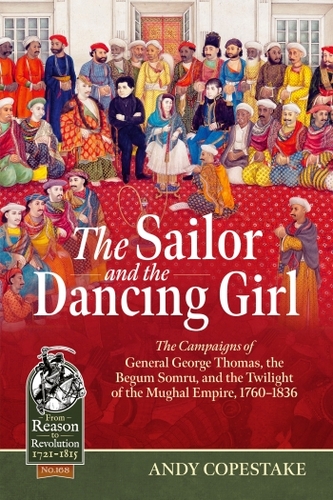
The Sailor and the Dancing Girl
The collapse of the Mughal Empire in the eighteenth century created one of the most violent and fascinating periods in Indian history. As imperial authority crumbled, ambitious rulers, European adventurers, mercenary armies and emerging regional powers fought almost continuously for territory, wealth and survival. It was an age in which loyalty could be bought, fortunes won and lost in a single campaign, and remarkable individuals could rise from obscurity to rule kingdoms.
Among the most extraordinary of these figures were George Thomas and Farzana, the Begum Somru.
Thomas was an Irish sailor who deserted into India, became a mercenary officer, carved out his own independent state in Hariana, established an arsenal, mint and army of his own, and dreamed of conquering the Punjab. Farzana began life as a dancing girl before becoming the wife of the German mercenary Walter Reinhardt ('Somru'), inheriting his famous brigade and eventually ruling the principality of Sardhana while playing a pivotal role in the politics of the dying Mughal Empire, becoming the adopted daughter of the Emperor Shah Alam II. Few careers in military history are more improbable.
The Sailor and the Dancing Girl tells both stories against the wider backdrop of the Anarchy in eighteenth-century India. Beginning with the rise of European-trained mercenary forces after Plassey and Buxar, Andy Copestake explores the transformation of Indian warfare as traditional armies increasingly adopted European drill, artillery and organisation. The book follows the careers of Walter Reinhardt, René Madec and other European military adventurers before tracing the intertwined lives of George Thomas and Begum Somru through decades of almost continuous campaigning across northern India.
Campaign by campaign, the narrative examines the struggles between the Mughal court, the Maratha Confederacy, Rajput states, Sikh misls, Rohilla chiefs and the expanding East India Company. Readers are taken through sieges, field battles, political intrigues, mutinies, shifting alliances and personal rivalries that shaped the future of the Indian subcontinent during one of its most turbulent eras. The result is both a gripping narrative and a detailed study of military operations during the final decades of Mughal power.
Alongside the military narrative, the book provides detailed examinations of the organisation, recruitment, uniforms and equipment of the famous Somru Brigade and George Thomas's own forces, supported throughout by specially commissioned artwork, maps and contemporary illustrations. The appendices include a register of known European officers serving with the Somru Brigade and Thomas's army, making the volume an important reference work as well as an engaging history.
Bringing together extensive primary research and modern scholarship, Andy Copestake reveals a forgotten world in which European soldiers of fortune, Indian rulers and ambitious adventurers fought to shape the future of northern India. The result is a vivid account of an overlooked period of military history and the remarkable careers of two individuals whose lives were stranger than fiction.
Among the most extraordinary of these figures were George Thomas and Farzana, the Begum Somru.
Thomas was an Irish sailor who deserted into India, became a mercenary officer, carved out his own independent state in Hariana, established an arsenal, mint and army of his own, and dreamed of conquering the Punjab. Farzana began life as a dancing girl before becoming the wife of the German mercenary Walter Reinhardt ('Somru'), inheriting his famous brigade and eventually ruling the principality of Sardhana while playing a pivotal role in the politics of the dying Mughal Empire, becoming the adopted daughter of the Emperor Shah Alam II. Few careers in military history are more improbable.
The Sailor and the Dancing Girl tells both stories against the wider backdrop of the Anarchy in eighteenth-century India. Beginning with the rise of European-trained mercenary forces after Plassey and Buxar, Andy Copestake explores the transformation of Indian warfare as traditional armies increasingly adopted European drill, artillery and organisation. The book follows the careers of Walter Reinhardt, René Madec and other European military adventurers before tracing the intertwined lives of George Thomas and Begum Somru through decades of almost continuous campaigning across northern India.
Campaign by campaign, the narrative examines the struggles between the Mughal court, the Maratha Confederacy, Rajput states, Sikh misls, Rohilla chiefs and the expanding East India Company. Readers are taken through sieges, field battles, political intrigues, mutinies, shifting alliances and personal rivalries that shaped the future of the Indian subcontinent during one of its most turbulent eras. The result is both a gripping narrative and a detailed study of military operations during the final decades of Mughal power.
Alongside the military narrative, the book provides detailed examinations of the organisation, recruitment, uniforms and equipment of the famous Somru Brigade and George Thomas's own forces, supported throughout by specially commissioned artwork, maps and contemporary illustrations. The appendices include a register of known European officers serving with the Somru Brigade and Thomas's army, making the volume an important reference work as well as an engaging history.
Bringing together extensive primary research and modern scholarship, Andy Copestake reveals a forgotten world in which European soldiers of fortune, Indian rulers and ambitious adventurers fought to shape the future of northern India. The result is a vivid account of an overlooked period of military history and the remarkable careers of two individuals whose lives were stranger than fiction.
Price:
NZ$ 69.99
Author:
Publisher:
Bind:
Paperback
Pages:
230
Dimensions:
156 x 234 mm
Publication Date:
30 July 2026
Availability Date:
31 January 2027
ISBN:
9781806722556
Tags:
Stock Status
Out Of Stock
View your shopping basket or Browse other items in MILITARY.
