
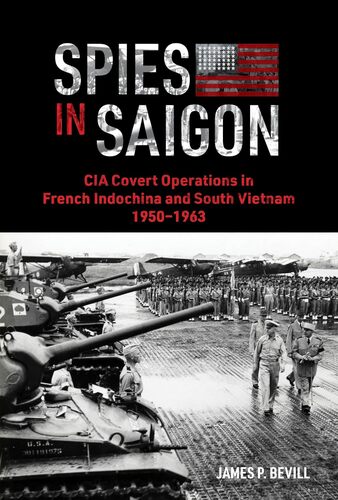
Spies in Saigon
This is the story that the CIA does not want you to read.
American involvement in Vietnamese politics began in the early 1950s. Using personal stories, eyewitness accounts, and recently declassified CIA reports from the field, author James P. Bevill describes the agency's clandestine efforts to block Vietnamese independence, then help create the Republic of South Vietnam.
Key among these primary sources are the CIA files of Paul L. Springer. Springer arrived in Saigon in May 1950. In 1951 he was named the CIA’s first chief of station in Indochina. In this role, during the French war against Ho Chi Minh and the China-backed Viet Minh revolutionary movement, he built the foundations of the American espionage network in Vietnam, Cambodia, and Laos.
Following the 2019 conclusion of a successful Freedom of Information Act (FOIA) lawsuit for the records of Paul Springer’s CIA files, the CIA information review officer argued that “plaintiff’s FOIA request could reasonably be expected to cause damage to national security by disclosing intelligence activities, sources, and methods.” Lost in this argument is that all the intelligence records related to Paul Springer’s service as chief of station were over fifty-five years old. The countries they pertained to no longer existed, and any of their perceived adversaries had long since died.|America’s involvement in Vietnam began in the early 1950s. Using personal stories, eyewitness accounts, and recently declassified CIA reports from the field, author James P. Bevill describes the agency's clandestine efforts to block Vietnamese independence, then help create the Republic of South Vietnam.
Key among these primary sources are the CIA files of Paul L. Springer. Springer arrived in Saigon in May 1950. In 1951 he was named the CIA’s first chief of station in Indochina. In this role, during the French war against Ho Chi Minh and the China-backed Viet Minh revolutionary movement, he built the foundations of the American espionage network in Vietnam, Cambodia, and Laos.
Following the 2019 conclusion of a successful Freedom of Information Act (FOIA) lawsuit for the records of Paul Springer’s CIA files, the CIA information review officer argued that “plaintiff’s FOIA request could reasonably be expected to cause damage to national security by disclosing intelligence activities, sources, and methods.” Lost in this argument is that all the intelligence records related to Paul Springer’s service as chief of station were over fifty-five years old. The countries they pertained to no longer existed, and any of their perceived adversaries had long since died.
American involvement in Vietnamese politics began in the early 1950s. Using personal stories, eyewitness accounts, and recently declassified CIA reports from the field, author James P. Bevill describes the agency's clandestine efforts to block Vietnamese independence, then help create the Republic of South Vietnam.
Key among these primary sources are the CIA files of Paul L. Springer. Springer arrived in Saigon in May 1950. In 1951 he was named the CIA’s first chief of station in Indochina. In this role, during the French war against Ho Chi Minh and the China-backed Viet Minh revolutionary movement, he built the foundations of the American espionage network in Vietnam, Cambodia, and Laos.
Following the 2019 conclusion of a successful Freedom of Information Act (FOIA) lawsuit for the records of Paul Springer’s CIA files, the CIA information review officer argued that “plaintiff’s FOIA request could reasonably be expected to cause damage to national security by disclosing intelligence activities, sources, and methods.” Lost in this argument is that all the intelligence records related to Paul Springer’s service as chief of station were over fifty-five years old. The countries they pertained to no longer existed, and any of their perceived adversaries had long since died.|America’s involvement in Vietnam began in the early 1950s. Using personal stories, eyewitness accounts, and recently declassified CIA reports from the field, author James P. Bevill describes the agency's clandestine efforts to block Vietnamese independence, then help create the Republic of South Vietnam.
Key among these primary sources are the CIA files of Paul L. Springer. Springer arrived in Saigon in May 1950. In 1951 he was named the CIA’s first chief of station in Indochina. In this role, during the French war against Ho Chi Minh and the China-backed Viet Minh revolutionary movement, he built the foundations of the American espionage network in Vietnam, Cambodia, and Laos.
Following the 2019 conclusion of a successful Freedom of Information Act (FOIA) lawsuit for the records of Paul Springer’s CIA files, the CIA information review officer argued that “plaintiff’s FOIA request could reasonably be expected to cause damage to national security by disclosing intelligence activities, sources, and methods.” Lost in this argument is that all the intelligence records related to Paul Springer’s service as chief of station were over fifty-five years old. The countries they pertained to no longer existed, and any of their perceived adversaries had long since died.
Price:
NZ$ 100.00
Author:
Publisher:
Bind:
Hardback
Pages:
496
Dimensions:
152 x 229 mm
Publication Date:
28 May 2026
Availability Date:
30 August 2026
ISBN:
9780764370793
Stock Status
In Stock
View your shopping basket or Browse other items in MAY / JUNE 2026.
