
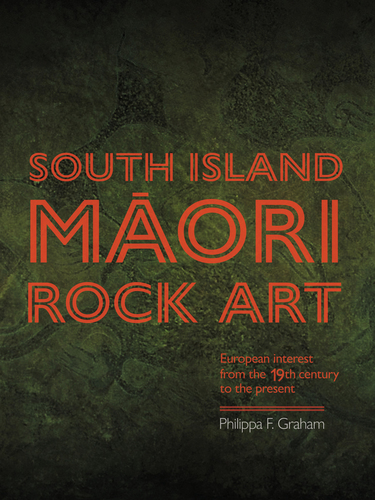
South Island Maori Rock Art
South Island Māori rock drawings, dating back to early Māori occupation, were examined as scientific curiosities by many early European explorers and, later, museum curators, including Julius von Haast, Alexander Hamilton, Robert
Speight, W.H. Skinner and H.D. Skinner. Early on there was the inevitable debate in European circles about the artistic merits of the rock drawings, but their value to both local and international collectors is indicated by the fact that many artworks were vandalised – in 1916, motifs were first cut out of major sites by one Mr Elmore, a visiting American, encouraged by a few acquisitive museum curators.
South Island Māori Rock Art: European interest from the 19th century to the present is the culmination of many years of exploring and checking the sites by local farmer Philippa Graham, encouraged by landowners, field staff from the
Department of Lands and Survey and the New Zealand Historic Places Trust. Examination of the Historic Places Trust records revealed numerous past reports about the drawings but little effective protection until recent years, and little has been written about the history of these fascinating sites since Michael Trotter and Beverley McCulloch’s popular 1971 publication, Prehistoric Rock Art of New Zealand.
In South Island Māori Rock Art, Graham calls on her in-depth research at all of the major New Zealand institutions, in addition to the Thomas Burke Museum, Seattle. She has uncovered a plethora of fresh material about the sites, the landowners, the governments of the times, archaeologists’
contributions, museums’ involvement, library records and attitudes towards local Māori in early days. Accompanied by more than 350 illustrations and maps, an index and a Māori glossary, South Island Māori Rock Art concludes with a chapter focusing on New Zealand artists who have been inspired by the rock drawings.
Speight, W.H. Skinner and H.D. Skinner. Early on there was the inevitable debate in European circles about the artistic merits of the rock drawings, but their value to both local and international collectors is indicated by the fact that many artworks were vandalised – in 1916, motifs were first cut out of major sites by one Mr Elmore, a visiting American, encouraged by a few acquisitive museum curators.
South Island Māori Rock Art: European interest from the 19th century to the present is the culmination of many years of exploring and checking the sites by local farmer Philippa Graham, encouraged by landowners, field staff from the
Department of Lands and Survey and the New Zealand Historic Places Trust. Examination of the Historic Places Trust records revealed numerous past reports about the drawings but little effective protection until recent years, and little has been written about the history of these fascinating sites since Michael Trotter and Beverley McCulloch’s popular 1971 publication, Prehistoric Rock Art of New Zealand.
In South Island Māori Rock Art, Graham calls on her in-depth research at all of the major New Zealand institutions, in addition to the Thomas Burke Museum, Seattle. She has uncovered a plethora of fresh material about the sites, the landowners, the governments of the times, archaeologists’
contributions, museums’ involvement, library records and attitudes towards local Māori in early days. Accompanied by more than 350 illustrations and maps, an index and a Māori glossary, South Island Māori Rock Art concludes with a chapter focusing on New Zealand artists who have been inspired by the rock drawings.
Price:
NZ$ 89.99
Author:
Publisher:
Bind:
Hardback
Pages:
352
Publication Date:
1 September 2026
Availability Date:
1 September 2026
ISBN:
9780473415860
Stock Status
In Stock
View your shopping basket or Browse other items in JULY / AUGUST 2026.
